
How it works · 7 min read
Why your tub looks dirty no matter how much you clean it
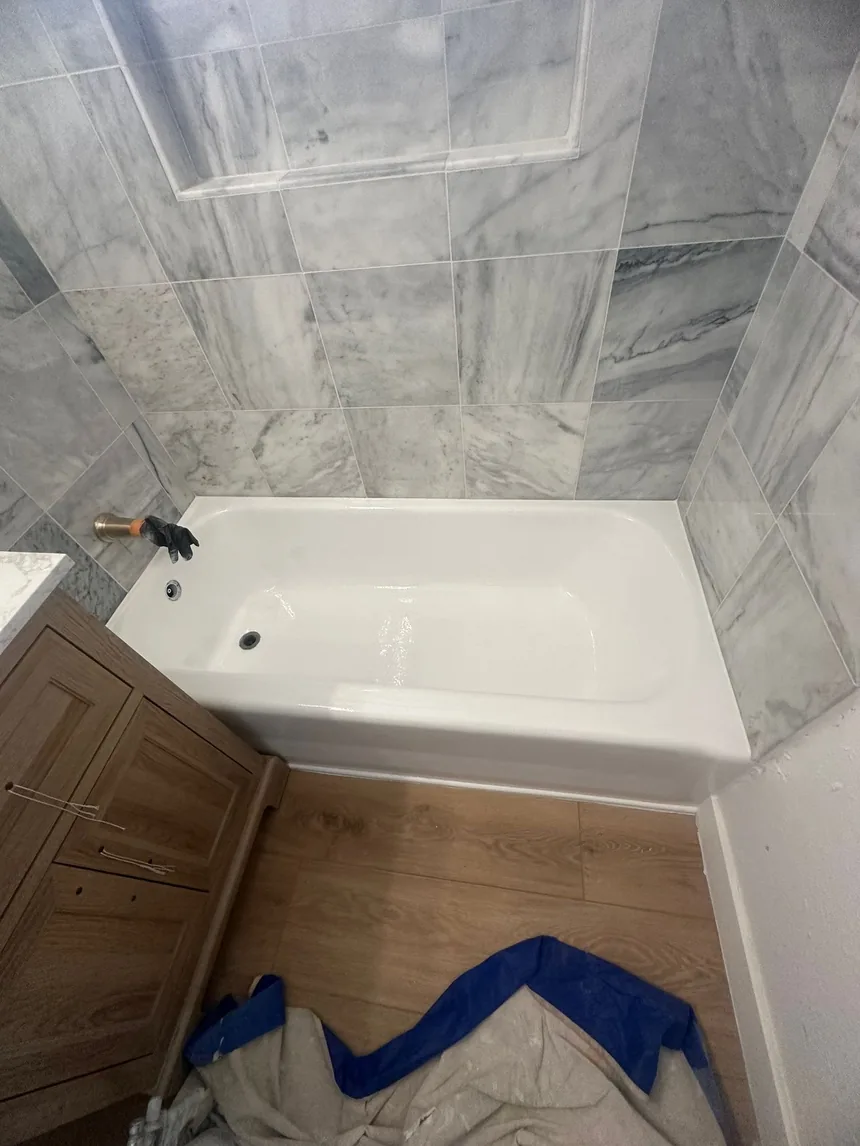
There is a specific kind of frustration that brings people to this trade, and it is not a chipped tub or a rusted one. It is a tub that is genuinely clean and still looks dirty. You scrub it, it looks fine while it is wet, and then it dries and the gray comes back.
That is not a cleaning failure. It is a surface that has stopped being smooth, and no product on a supermarket shelf will fix it.
What a glaze actually does
A new bathtub surface — porcelain glaze on a metal tub, gelcoat on a fiberglass one — is non-porous. At the scale that matters, it is a sealed sheet. Dirt lands on it and sits there, which is why a new tub wipes clean with a cloth and almost no effort.
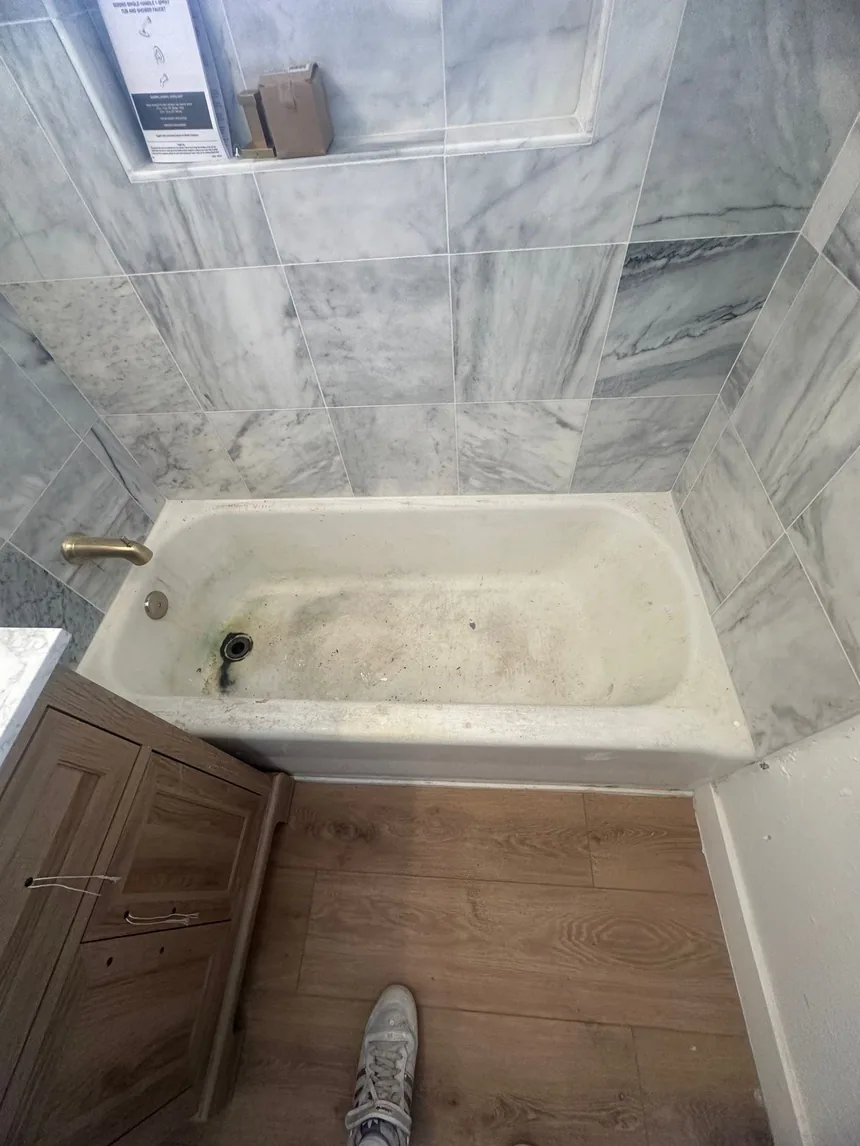
Over years that sheet gets worn. Abrasive cleaners sand it. Hard water deposits are scraped off, taking a little surface with them each time. The gloss goes first, and underneath it the surface is no longer sealed — it is a landscape of microscopic pits.
Now dirt does not sit on the surface. It sits in it. And a cloth cannot reach into a pit, so what you are cleaning is only the top.
The wet test
There is a quick way to confirm this is what you have, and it takes thirty seconds.
Clean a section of the tub, rinse it, and look at it while it is still wet. Then watch it dry.
If it looks even and bright when wet and goes patchy or gray as it dries, your surface is porous. Water fills the pits and makes the surface optically flat again — which is exactly what a coating does permanently. If it looks the same wet and dry, you have a staining problem rather than a wear problem, and that is a different conversation.
The vicious circle
This is the part worth understanding, because it is the reason the problem accelerates.
A porous surface holds dirt. Dirt that will not wipe off invites scrubbing. Scrubbing with anything abrasive takes off more surface. More surface removed means more pores. More pores means more dirt held. Within a few years a tub can go from "needs a wipe" to "needs twenty minutes and a scouring pad", and the twenty minutes with the scouring pad is what guarantees the next stage.
We see the end of that circle constantly. It is the single most common reason a structurally perfect tub gets described by its owner as disgusting.
Southern California makes it worse
Water here is hard. Hard water leaves calcium and magnesium behind wherever it evaporates, and on a worn surface those minerals bond into the pits rather than sitting on top. That is the chalky gray film along the waterline and around the drain that comes back within days.
Acidic descalers shift it. They also attack the remaining glaze, which is why a tub that gets descaled aggressively every month ages far faster than one that does not. It is a genuine trap: the thing that removes the symptom accelerates the cause.
What does not work
- A stronger cleaner. The dirt is below the level a cleaner reaches.
- A magic-eraser block. It is a fine abrasive. It works by sanding, and sanding is the problem.
- Bleach. Lightens the color of what is in the pores for a few days. Removes nothing.
- Scouring powder. The fastest way to make next year worse.
- A bath mat left in place. Suction cups trap water and minerals against the surface permanently. Hang it up after every use — this one is free and it matters.
What does
Only two things, and they are different sizes of answer.
If the surface is tired but sound, a deep clean and new silicone in the corners can genuinely be enough. That is what we call reconditioning, and the honest part is that nothing gets applied over the surface — it is a clean and a reseal, not a coating. When that is all a bathroom needs, it is what we say, and it is the cheaper answer.
If the glaze is worn through, no clean is going to bring it back, because there is nothing left to bring back. Refinishing replaces the sealed layer: the surface is repaired, etched and coated, and what you end up with is non-porous again. Dirt sits on top of it. It wipes.
That is the whole claim, and it is a modest one. You are not buying a cleaner tub. You are buying back the property that made it easy to clean in the first place — and then not scrubbing it, which is what keeps it.
The one place it genuinely is not the surface
There is an exception worth knowing, because it saves people from resurfacing a tub that did not need it.
If the black is confined to the line where the tub meets the tile, the surface is not your problem. That line is caulk, not glaze and not grout, and old caulk goes black from the inside where no cleaner can reach. It does not clean, it gets replaced — the old bead comes out and a new one goes in. On a tub that is otherwise sound, that plus a deep clean is the whole job, and it is the cheaper answer.
The same goes for a ring that is only at the waterline and nowhere else: that is mineral scale from hard water sitting on an otherwise intact surface, and it will shift. The wear pattern that needs refinishing is in the floor of the tub, where feet go, and it is gray rather than brown.
Which one you need
Send a photo, taken in daylight, of the dry tub. We have been looking at these for ten years across Los Angeles and we can usually tell worn from stained from a picture. If the answer is that yours needs a clean rather than a coating, that is what we will tell you.