
What to expect · 7 min read
How to get your bathroom ready for a refinisher
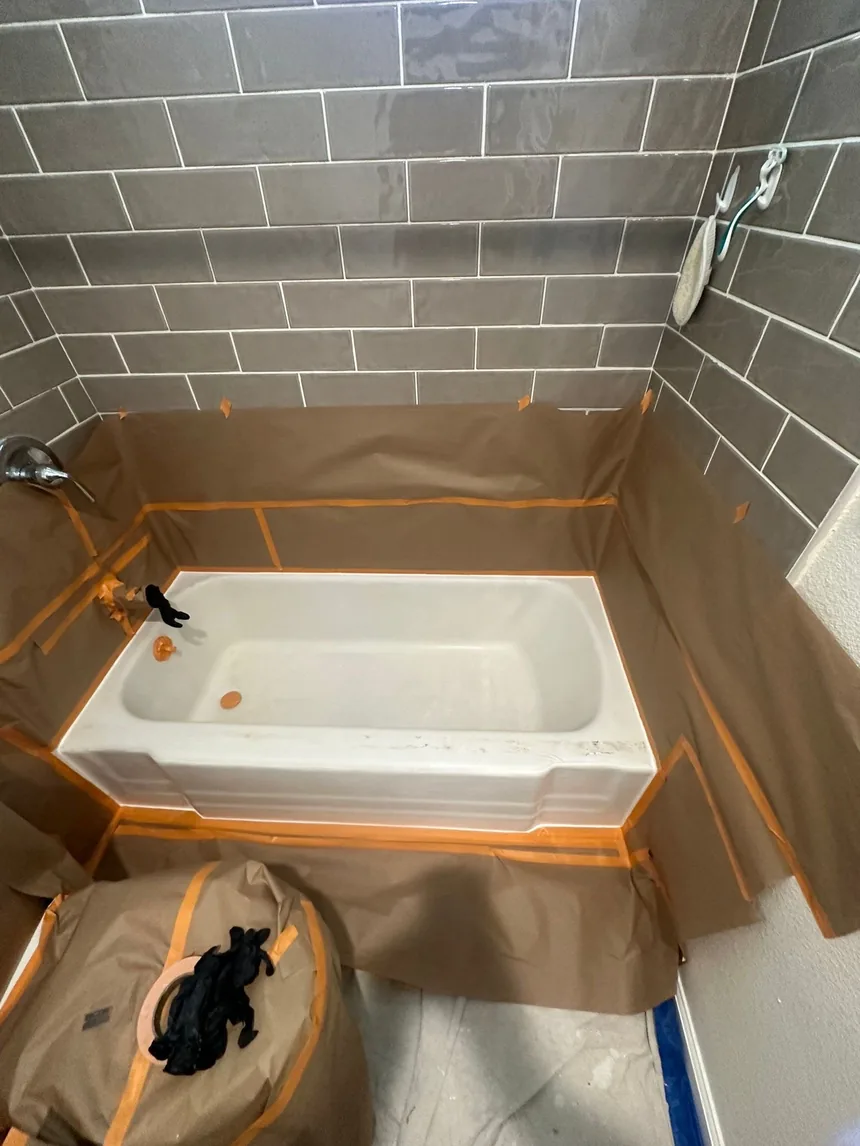
Most of the preparation for a refinishing job is ours, and it is the majority of the time we spend in your house. What you need to do takes about ten minutes. It is worth doing it the night before rather than while two people are standing in your hallway.
The night before: clear the room
- Empty the tub and the shower completely. Bottles, razors, the caddy, the loofah, the kids' toys, the bar of soap in the dish. Everything.
- Take down the shower curtain or open the door fully. A curtain is in the way and it will get overspray if it stays.
- Clear the vanity and any open shelving in the room. Toothbrushes, makeup, medication, towels. Anything on an open shelf in a sealed room is better out of it.
- Take the bath mat and the rugs out. Including the one around the base of the toilet.
- Take anything off the walls you would rather not have taped around — pictures, a mirror that is not fixed, a towel ring if it is in the way.
If you want to clean the tub first, a normal wipe is plenty and genuinely helps. Do not use anything abrasive and do not use anything oily or waxy — a tub treated with a "shine" product is a tub that needs more degreasing, not less.
The practical things people forget
- Parking. We need somewhere to put the van within reach of the door, and in a lot of Los Angeles that is the single biggest variable in whether a job starts at eight or at nine. If your street is permit-only, say so when you book.
- Access to the bathroom window. A blower fan exhaust goes in the window and runs for the whole job. If the window is painted shut, stuck, or behind a security screen, tell us in advance — it changes how we set the room up.
- Power. A working outlet near the bathroom.
- In a building: elevator access, the service entrance, whether the association needs anything from us, and the hours the building allows work. Condos and apartments have their own list, and it is worth going through it before the day.
People and animals
José would rather you were not in the house while the work is going on. If you can be out for the few hours, be out. If you cannot — and plenty of people cannot — you can be in the living room or the kitchen with the bathroom sealed and the exhaust running.
Pets should be somewhere else entirely, and birds should be out of the house rather than in another room. If anyone in the household has a respiratory condition, say so when you book rather than on the day. The longer answer about fumes and ventilation covers what is and is not true about low-VOC products, including the parts that are less reassuring than the advertising.
What the day looks like
Roughly, and in this order.
- Setting up. Floor covered, toilet bagged, fixtures, vanity and anything else not being coated masked in paper and plastic. The exhaust goes in the window. The room is sealed from the rest of the house.
- Repairs. Chips, cracks, rust and loose tile dealt with — ground out, filled, cured, sanded flat. This is the part that decides whether the finish lasts, and it is the slowest part of the day.
- Cleaning and etching. The surface is degreased and etched so the coating has something to bond to.
- Spraying. The shortest part by a distance.
- Unmasking and clearing out. Everything that came in goes out with us.
Three to five hours, in one visit. It is one visit on purpose — we are not coming back for a second coat on another day.
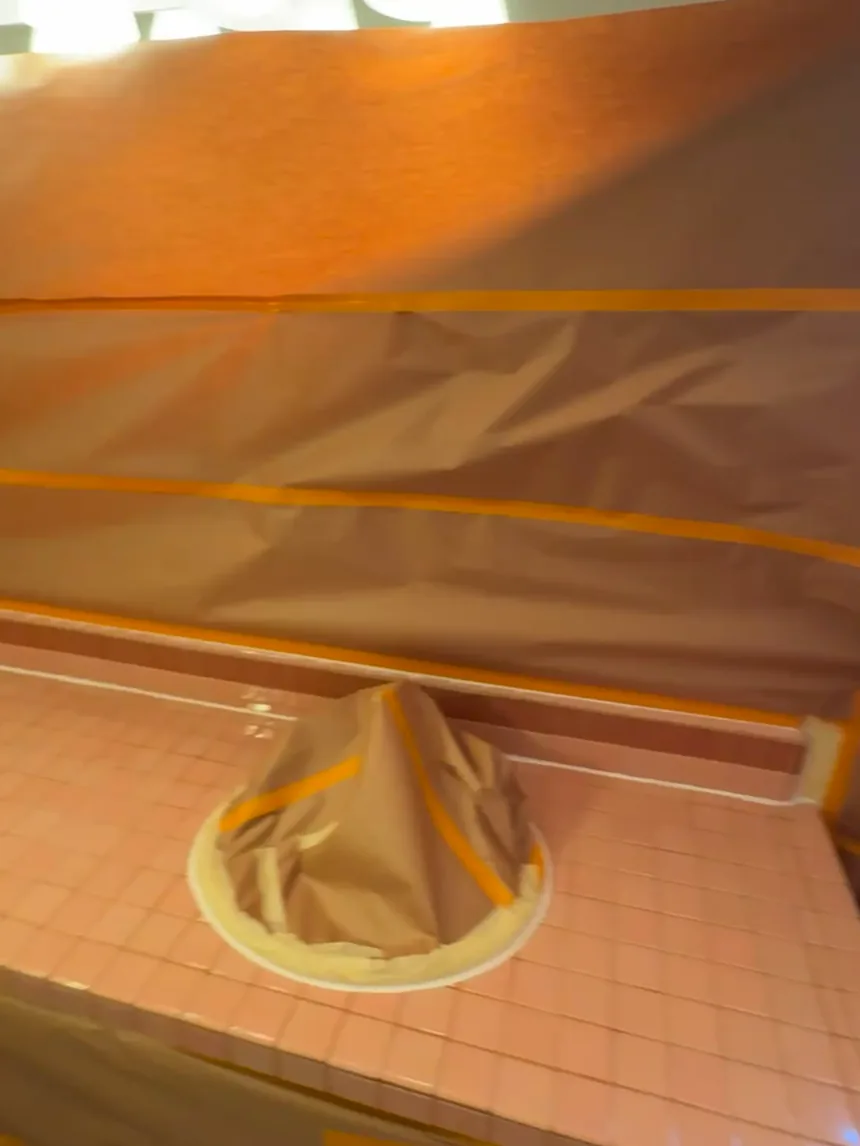
After we leave
One number matters: twenty-four hours from when we finish before the tub gets wet or takes any weight. Not twelve because it looks dry. Using it early is the single most common way a good job gets ruined and it cannot be undone afterward.
If we ran fresh silicone where the tub meets the tile, leave it alone — it has its own drying time, usually longer than the finish. Air the room out, window open and fan on, which helps the smell fade and costs nothing.
Then the rules get very short, and they are mostly about not scrubbing: the aftercare is one page and following it is the difference between a finish that lasts years and one that does not.
What we are not going to do, and why that is worth knowing
We refinish surfaces. We do not remodel and we do not do plumbing, and the reason to say that before the day rather than during it is that it changes what you should expect from the visit.
- We do not remove or reset fixtures. Faucets, spouts and handles get masked, not taken off. If you want a faucet changed, have that done before we come, not after — new fixtures going into a freshly coated surface is a good way to damage it.
- We do not open walls. If the masking comes off and the wall behind the tile is soft, that is a different trade and we will tell you rather than coat over it.
- We do not fix leaks. A dripping faucet or a failed overflow seal should be sorted first. A drip onto a new finish keeps one spot permanently wet, which is the one thing a cured surface still does not like.
Two questions worth asking us on the day
- "Exactly what time can it be used?" Get the hour, not the day. Write it down.
- "Is there anything you found that I should know about?" Sometimes the masking comes off something — a soft spot, a leaking overflow, tile that is no longer bonded. We would rather tell you than cover it up, and that is the moment to ask.
We work Monday to Saturday, 7 AM to 7 PM, across Los Angeles, Orange and San Bernardino counties. Residential work carries a five-year written warranty.