
Safety · 8 min read
Is bathtub refinishing safe? The honest answer about fumes
This is the question people are most reluctant to ask out loud, usually because they have already read something alarming. It deserves a straight answer rather than reassurance, so here is what is true, what we do about it, and what we will not claim.
What is actually being sprayed
Refinishing means cleaning and etching the existing surface so it will bond, repairing what is damaged, and then spraying a coating over the whole thing. The coating is a two-part product that cures chemically rather than simply drying — which is why it ends up hard enough to live in a bathroom, and why it has a smell while it is going on.
We use Hawk and Topkote, and both are low-VOC. We name them because most companies will not, and because it is the one claim in this trade you can actually check.
What low-VOC means, and what it does not
This matters enough to spell out, because the term gets used as though it settles the question. It does not.
VOCs are volatile organic compounds — the solvents that evaporate out of a coating as it cures. A low-VOC product releases fewer of them than a conventional one. That is a real and meaningful difference, and it is the reason we use these products rather than cheaper ones.
But low-VOC does not mean odorless, and it does not mean you can treat the room as normal while the work is happening. Anyone who tells you a refinishing job has no smell is either selling something or has never been in the room. There is a smell. It is strongest during the spray itself and it drops off quickly once the room is cleared.
How the room is handled
Three things, and they happen on every job.
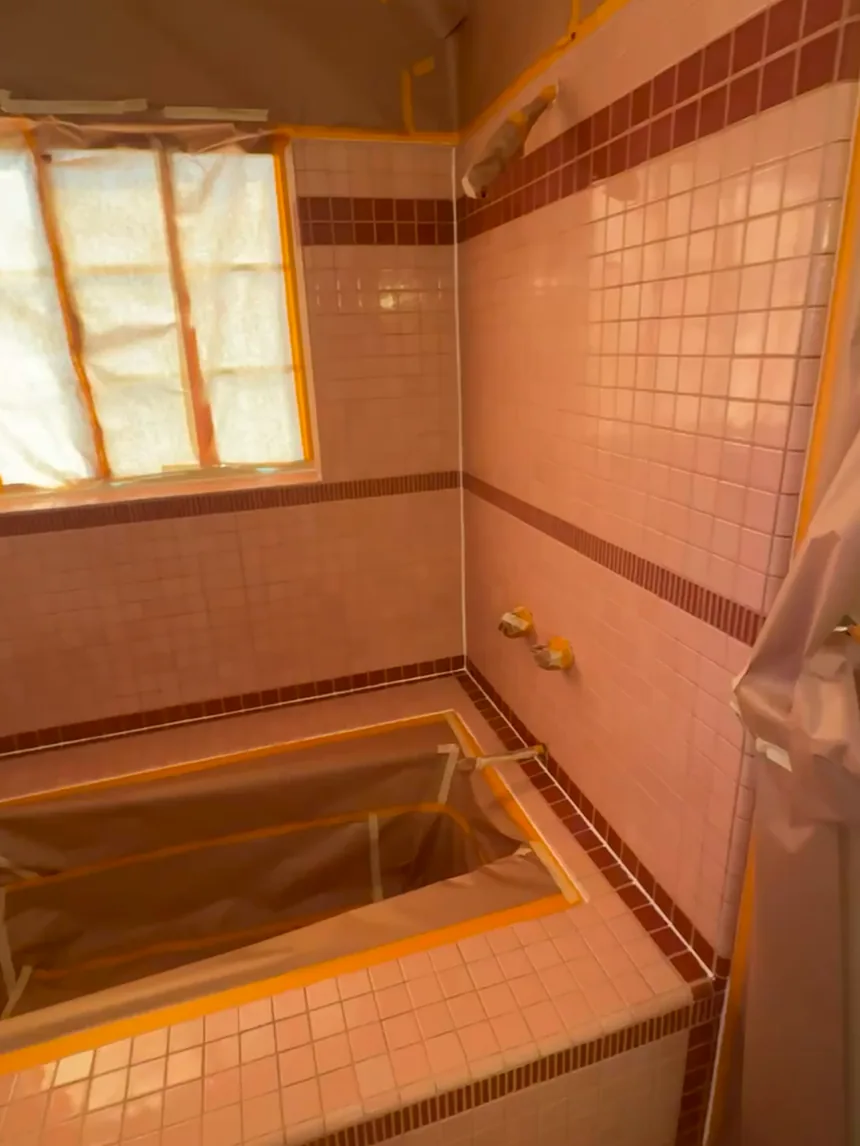
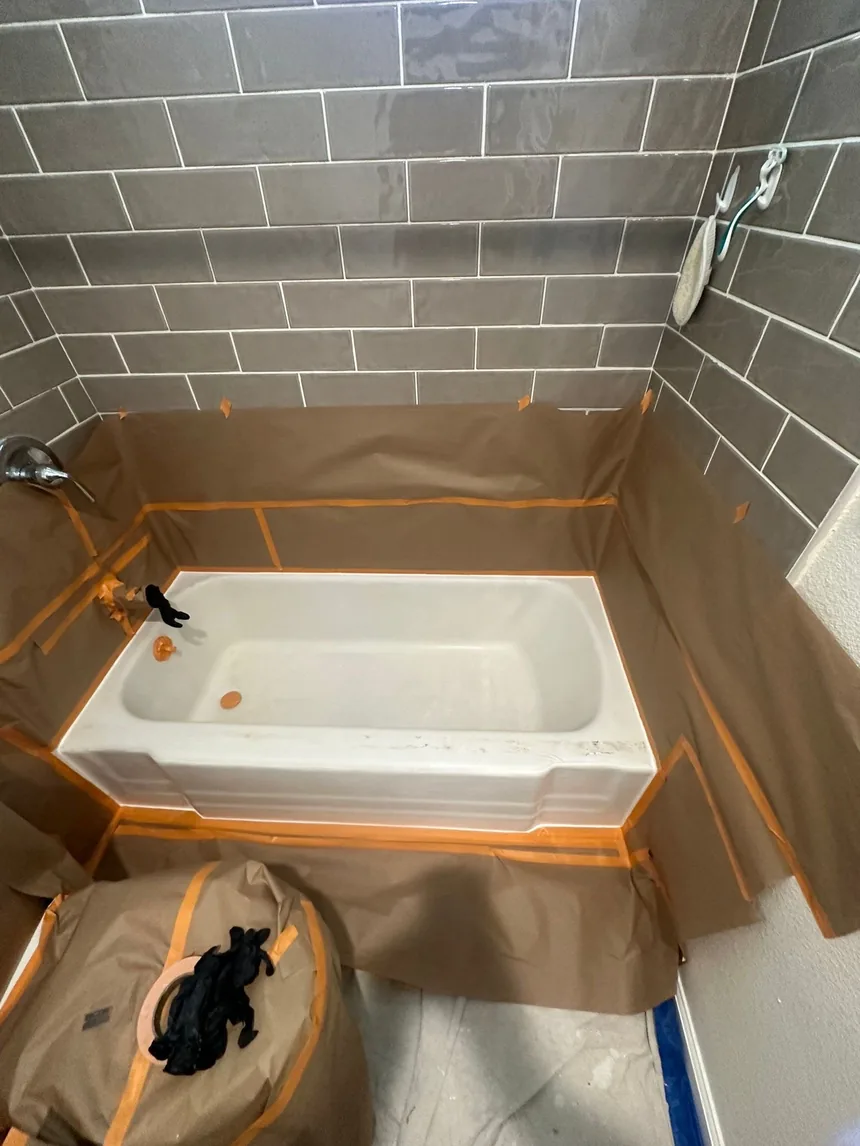
- Everything is masked. Floor, toilet, vanity, faucets, mirror — anything that is not being coated gets covered in paper and plastic. That is partly about overspray and partly about containment: a sealed room is a room the rest of the house is not sharing air with.
- We bring a blower fan exhaust. It goes in the window and pulls the vapor out of the room and outside, continuously, while the work is going on. The air in the bathroom is being replaced the whole time rather than left to settle.
- The crew wears the respiratory protection the product requires. That is for them, and it is a reasonable thing to look for when anyone is working in your house.
Can you stay in the house?
Here is the answer José gives, in both halves, because the second half on its own would be misleading.
He would rather you were not in the house. That is the honest preference and we are not going to dress it up. If you can be out for the few hours it takes, be out.
But if you cannot, you can stay in the living room or the kitchen. Plenty of our customers work from home, and plenty of the units we do have a tenant in place who is not going anywhere. With the room sealed and the exhaust running, being at the other end of the home is workable. What is not workable is being in and out of the bathroom, or in the room next to it with the door open.
For occupied rental units there is also an odor-reducing additive we can use. It exists precisely for the case where somebody is living there and cannot leave. Two honest caveats: it reduces odor, it does not remove it, and it is not a reason to skip the ventilation.
Children, pets and anyone with a respiratory condition
Tell us beforehand. It changes nothing about the method and everything about the scheduling.
- Pets. Birds especially — their respiratory systems are far more sensitive than ours. A bird should be out of the house, not in another room.
- Small children. Easiest to plan around by not being home, and most parents choose that anyway.
- Asthma, COPD, pregnancy, chemical sensitivity. Say so when you book. We are not doctors and will not pretend to be — if you have a condition, the question is one for your doctor and not for a refinishing company. What we can do is tell you exactly what happens and when, so you can make the decision with real information.
Afterward
The smell drops sharply once the spraying stops and the room is opened up, and it keeps fading over the following day. Airing the bathroom out — window open, fan on — helps and costs nothing.
Separately from the smell, there is the cure. Twenty-four hours from when we finish before the tub gets wet or takes weight. That one is not a comfort question, it is the thing that decides whether the finish lasts, and using it early is the most common way a good job gets ruined.
The summary
- There is a smell. Low-VOC reduces it; it does not remove it.
- We name the products: Hawk and Topkote, both low-VOC.
- The room is sealed and vented outside with a blower fan the whole time.
- Out of the house is better. The living room or kitchen is workable if you cannot be.
- For occupied units there is an odor-reducing additive.
- Tell us about pets, children or any respiratory condition when you book.
- Twenty-four hours before the tub is used.
If the honest version makes the job sound less magical than the advertising does, that is deliberate. We would rather you knew what the day looks like before we arrive.